Leave Your Message
- Phone
- E-mail
- Whatsapp
- WeChat

Selecting reliable machinery is becoming a strategic decision for pipe manufacturers. The World Steel Association reported 1,888.2 million tonnes of crude steel production in 2023. That volume reflects continuing demand for forming, welding, cutting, and finishing equipment. PlasticsEurope also reported global plastics production of about 400.3 million tonnes in 2022, supporting investment in extrusion and plastic pipe systems. These figures show why supplier capability matters beyond the machine’s purchase price.
This guide examines the Top 10 High Quality Pipe Machine Equipment Suppliers through practical, measurable criteria. Production experience, machine stability, automation, energy use, after-sales support, and documented quality controls all matter. A dependable supplier should provide verifiable factory references, clear tolerances, spare-parts planning, and operator training. ISO 9001 certification can indicate a controlled quality system, but certification alone proves little. Real performance matters more.
Look closely at the details. Does the line maintain wall thickness during long production runs? Can the welding unit hold alignment when temperature changes? Are electrical drawings, test records, and maintenance schedules available? These questions reveal more than polished brochures. The ranking is not a perfect verdict, because application needs differ across steel, stainless steel, copper, and polymer pipes. A supplier suitable for high-volume construction pipe may perform poorly in precision tubing. Readers should validate every claim through site visits, sample trials, and independent technical checks before making a purchase.
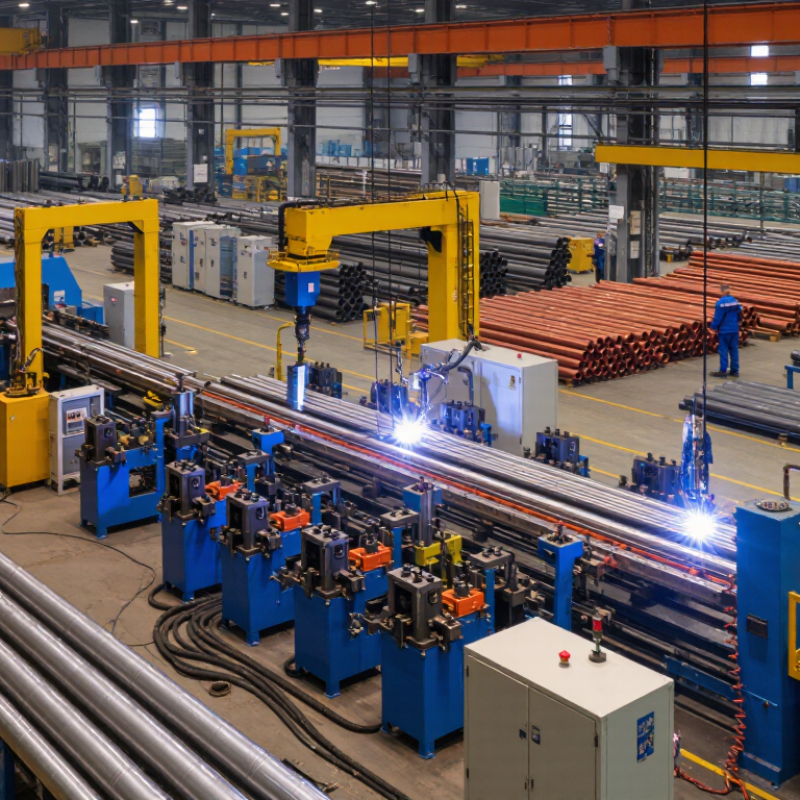
Pipe machine equipment suppliers provide more than individual machines. They often design complete production lines for tube forming, welding, sizing, cutting, and end finishing. A reliable supplier studies the pipe material, diameter range, wall thickness, and expected output before recommending equipment. This prevents an oversized machine from wasting energy or an undersized line from causing repeated stoppages.
Their service usually includes forming rolls, welding systems, cutting units, control cabinets, measuring tools, and safety guards. Many suppliers also provide layout drawings, installation guidance, operator training, and commissioning support. Practical details matter. For example, a cutting unit should leave clean ends without excessive burrs. A roll set should change efficiently when production shifts between pipe sizes. Spare sensors, bearings, and electrical components can reduce costly downtime.
Experienced suppliers may offer trial production, quality inspection plans, and documentation for maintenance and operation. They can help adjust welding power, line speed, cooling flow, and alignment during testing. However, no recommendation is perfect without accurate production data. A quotation may look complete but still overlook floor space, material variation, or local maintenance skills. Buyers should question unclear promises and request measurable performance targets. Reliable communication after delivery is equally important. The best supplier remains available when vibration appears, dimensions drift, or operators need practical advice. Small details often decide whether equipment performs smoothly for years.
| No. | Equipment Category | Main Production Process | Typical Pipe Range | Common Materials | Automation Features | Testing and Quality Functions | Typical Supplier Support |
|---|---|---|---|---|---|---|---|
| 1 | ERW Pipe Mill | High-frequency electric resistance welding for longitudinal pipe seams. | Approximately 20–630 mm outside diameter, depending on the mill configuration. | Carbon steel, galvanized steel, stainless steel, and low-alloy steel strip. | Automatic strip alignment, speed control, weld monitoring, and touchscreen HMI. | Online weld inspection, dimensional measurement, hydrostatic testing, and end facing. | Layout design, mill commissioning, tooling, operator training, and maintenance support. |
| 2 | Spiral Welded Pipe Mill | Helical forming and submerged arc welding of steel strip. | Approximately 219–3,000 mm outside diameter. | Carbon steel and low-alloy steel plate or coil. | Automatic forming control, weld tracking, strip tension control, and cut-to-length systems. | Ultrasonic or radiographic weld inspection, hydrotesting, bevel inspection, and dimensional checks. | Process engineering, welding procedure support, spare parts, installation, and production training. |
| 3 | Seamless Tube Production Line | Rotary piercing, elongation, sizing, heat treatment, and finishing. | Commonly about 20–660 mm outside diameter, subject to mill design. | Carbon steel, alloy steel, stainless steel, and heat-resistant grades. | Automatic billet feeding, temperature control, pass-line monitoring, and production data logging. | Eddy-current testing, ultrasonic testing, hardness checks, wall-thickness measurement, and hydrotesting. | Mill engineering, roll and tool design, process optimization, commissioning, and technical training. |
| 4 | Precision Tube Mill | Cold forming, sizing, drawing, or pilger processing for close-tolerance tubes. | Typically 6–219 mm outside diameter with controlled wall thickness. | Stainless steel, carbon steel, copper alloys, aluminum alloys, and nickel alloys. | Servo-driven forming, automatic gauge control, recipe management, and inline length measurement. | Surface inspection, dimensional gauging, eddy-current testing, and material traceability. | Tooling design, calibration assistance, line integration, preventive maintenance, and upgrades. |
| 5 | Pipe Galvanizing Line | Surface preparation followed by hot-dip zinc coating and finishing. | Commonly designed for small, medium, or large diameter pipe ranges. | Carbon steel and ductile iron pipe prepared for zinc coating. | Automatic flux control, zinc temperature regulation, coating-speed control, and fume extraction. | Coating thickness measurement, adhesion checks, visual inspection, and surface uniformity testing. | Furnace design, environmental-control integration, zinc recovery systems, installation, and training. |
| 6 | Pipe Coating Line | External or internal application of fusion-bonded epoxy, polyethylene, polypropylene, or paint coatings. | Suitable for line pipe, structural pipe, and process pipe in various diameters. | Carbon steel, alloy steel, and prepared welded or seamless pipe. | Automatic preheating, powder or liquid application, conveyor control, and curing-temperature monitoring. | Holiday detection, coating-thickness measurement, adhesion testing, and visual surface inspection. | Coating-system selection, line balancing, application trials, commissioning, and service contracts. |
| 7 | Pipe End Finishing Machine | Cutting, chamfering, beveling, threading, facing, and deburring of pipe ends. | Configured for small, medium, or large diameter pipe and tube products. | Carbon steel, stainless steel, alloy steel, copper alloys, and aluminum alloys. | CNC positioning, automatic chucking, tool compensation, and integrated chip removal. | Thread gauging, bevel-angle verification, end-face inspection, and dimensional measurement. | Custom tooling, programming, installation, operator instruction, and replacement components. |
| 8 | Pipe Straightening and Sizing Line | Multi-roll straightening, calibration, and dimensional correction. | Commonly used for round pipe, rectangular tube, and structural hollow sections. | Carbon steel, stainless steel, alloy steel, and nonferrous metal tubes. | Roll-gap adjustment, automatic pass-line control, servo feeding, and digital parameter storage. | Straightness measurement, outside-diameter checks, corner-radius inspection, and surface inspection. | Roll design, product changeover assistance, commissioning, alignment, and maintenance support. |
| 9 | Hydrostatic Pipe Testing System | Water-pressure testing to verify pipe strength and leak tightness. | Designed according to pipe diameter, length, pressure, and applicable specification. | Welded and seamless steel pipe, stainless steel pipe, and selected nonferrous products. | Automatic filling, air removal, pressure ramping, holding-time control, and data recording. | Pressure calibration, leak detection, test-record generation, and traceable measurement systems. | Test-cycle development, safety integration, calibration support, commissioning, and staff training. |
| 10 | Pipe Handling and Packaging System | Conveying, bundling, weighing, marking, stacking, and final packaging. | Adaptable to short or long pipe, loose products, and bundled production lines. | Steel pipe, stainless steel tube, galvanized pipe, and coated pipe products. | Automatic counting, weighing, strapping, labeling, barcode tracking, and warehouse interface. | Bundle verification, weight confirmation, marking inspection, and production traceability. | Material-flow planning, custom automation, safety guarding, integration, and after-sales support. |